Advertise


See Xclusive ...

Friday, 22 March 2013

CONFESSION: Indian Hair Chased Me - Rachel Edjeren

0 comments
Below is a story Abuja based TV producer/ presenter and blogger, Rachel Edjeren, shared some days back on her BLOG about the day she was chased in a dream by the Indian hair she fixed..
"My sister in-law came to pray with me last two years. She said she was experiencing ill luck during the week. So many nasty things happening to her.
"I prayed wit her and the Spirit led me to ask her what hair she had on, she said Indian. I was led to tell her to remove it and not give out but pray and burn it. She obeyed and things went back to normal. Sometime after that, my hubby and I watched a documentary on how ladies in India sacrifice their hair to the gods if they have nothing else worthy to sacrifice.
Continue below.

My husband likes human hair. So even though I like my full dreadlocks kind of hairstyles, I give him what he likes most times. I have done brazilian and Peruvian hair so thought to try something different and more natural which is Indian hair.

Last weekend I ordered for it and made it. Prayed on it and believed it was fine. Yesterday night (march 14, 2013) I had the strangest of dreams. I saw that I made a hair that allowed me to pack it thus project my face and make it look slimmer. All of a sudden, I got into a scuffle wit 3 people who began to chase me all over the place to kill me. I got off from them narrowly and ran into a market. There, a mad man began to chase me.
 
Last weekend I ordered for it and made it. Prayed on it and believed it was fine. Yesterday night (march 14,2013)I had the strangest of dreams. I saw that I made a hair that allowed me to pack it thus project my face and make it look slimmer. All of a sudden, I got into a scuffle wit 3 people who began to chase me all over the place to kill me. I got off from them narrowly and ran into a market. There, a mad man began to chase me.

I escaped him narrowly then 2 Molester-thugs came after me. All the while, I felt I was carrying someone else’s face.

I ran into a house with people praying. The lady in charge there looked at me and showed me a picture of my self with my regular synthetic dread-like hair and said “but that is ur regular look, why are you carrying someone else's face. Then from no where another lovely lady came from outside, drew me to the corner and began to ask me about my look. She said “you are having problems with your hair right?” Whilst she was talking, I noticed something in her mouth; a bowl of cowries and the face of a Benin god. I looked closer and asked her what it was and why she had it.
She said her man likes her because of that decor in her mouth—cowries and the face of a god like a shrine in one’s mouth?
she also said that she is comfortable and that it’s beautiful.
I woke up and prayed and immediately understood what the message was but didn’t want to let go of my cute human hair that cost so much.
I decided to ask my husband because he interprets dreams accurately.
He immediately told me to remove the hair. At the same time, the Spirit told me to cut it off and not remove it gracefully because it tried to bring me shame and pain.
Cut it off, anoint your head, anoint and pray on the hair to refute all ill and do not just throw it away but BURN IT. I obeyed.
I have decided to only carry my natural hair or synthetic hair.
This is because the Bible says; “The hair is the woman’s crowning glory”. Carrying another’s is like carrying the other person’s spirit. The worst is even Indian. Nothing wrong with Indians; They are beautiful and we love them especially in Films but those hairs sold are sacrifices to gods. Thus, they are cursed.

There are loads of other human-looking hair made with synthetic in the market if you want that look or if you insist on wearing real human hair, try those from other Countries but pray on them and be ready to bear any consequence.
Read more...

BEWARE: Prepare For Deadly Flood

0 comments
Nigerians cannot forget the 2012 floods. According to official figures, 360 people lost their lives with more than two million rendered homeless. Some displaced people are still in camps in Delta, Kogi, and Lagos States.

The flooding began in July, at the peak of the rainy season, when the nation usually recorded the first of its double rainfall maxima, and lasted till December, when the dry season should be underway.

The worst hit states included Anambra, Bayelsa, Benue, Cross River, Delta, Edo, Kogi, Kwara, Osun, Oyo, Lagos, Ogun and Niger, and when the nation started counting losses, assets worth N300 billion had been lost. It was the most wide spread flooding in the country, and the worse in more than 80 years.

Yearly, the Nigerian Meteorological Agency, NIMET, makes public its weather predictions. It did so on February 15, noting excessive rains in Sokoto, Kebbi, Niger and Kwara States. “Predicted rainfall for the North West areas of Sokoto, Kebbi, Niger, Kwara and environs is likely to be above normal in comparison to 2012,” NIMET said.

Rainfall however is not the only source or cause of flooding. The state of the dams is another major source of flooding. At least 39 people died from flooding of the Lamingo Dam near Jos. It swept across a number of neighbourhoods, and about 200 homes were submerged.

Dams sometimes accumulate water beyond their capacity, to avoid such dams from bursting; the water they hold is measuredly released. This can cause flooding as has been witnessed in Jigawa, Ogun and Lagos States. Early March, the Federal Government ordered immediate evacuation of people living on the River Niger to avert another flood disaster.

The evacuation is necessary because the Jebba and Kainji dams had attained their highest water levels in 29 years.

All tiers of government should sensitise Nigerians to the dangers ahead. The people should also heed flood warnings. In our towns and cities, some people empty their garbage into drains, or the municipal authorities fail to collect refuse promptly. These practices could block drains and enhance flooding.

Besides, as towns and cities offer more opportunities, the rural-urban drift is on the increase.  The demand for more land for housing has led to indiscriminate constructions, mostly illegal, near water bodies.

In many instances, entire flood plains have been filled and converted to housing estates. Water thus displaced during the dry season will return as flood during the wet season.

Ministries of Environment in all the States have to be more alive to their responsibilities. Many of the affected areas are yet to recover from last year’s flood. These warnings should be heeded urgently as the rains are already here.
Read more...

DEADLY LOVE: Wife Poison, Stab Husband To Death?

0 comments
It was gory sight yesterday in Mgboshiminu community in Obio/Akpor Local Government of Rivers State as Charity Ovudah, 36, allegedly stabbed her husband to death after first poisoning his food.

The alleged murder said to have taken place in the night before was reportedly provoked by the deceased, Peter Ovudah’s attempt to bring a second wife into the matrimonial home he had shared with the alleged killer.

A family source said the decease had already concluded plans to bring the new wife, who was pregnant, into the family houset before Charity’s fatal reaction.

Mrs. Igbokwe Onyeka, a neighbour to the Ovudahs revealed that; “The family had been quarreling over the issue of a second wife but no one anticipated that Charity would be so angered killed her husband.

A 19-year-old housemaid to the Ovudahs, who gave her name as simply Loveth said she witnessed how Ovudah died, saying she first noticed that Charity added something to her husband’s food that fateful night.

she said: “I was the one who served the food for my aunt’s husband but my aunt added something that looked like salt and mixed it together.

“So when Oga came back and started eating I was monitoring him. After about 30 minutes he started behaving strange and fell off the dining chair, rolling on the floor and shouting for help.

“That was when my aunt came and stabbed him till he gave up”, she said.

The suspected killer was said to have disappeared the moment the housemaid alerted neighbours of her action, but the remains of the deceased has been deposited at the BraithwaiteMemorialHospital mortuary in Port Harcourt.
Read more...

TRAGEDY: Boat Carrying 166 Sink, Many Dead?

0 comments
Sahara Reporters has learned that most of the nearly 170 passengers traveling in a huge boat are feared dead in a disaster earlier Tuesday. The boat reportedly capsized some 40 nautical miles off the coast of Calabar.
The National Emergency Management Agency (NEMA) in Nigeria had earlier reported nine people dead and two survivors however eyewitnesses told our correspondent that the passengers were traveling in a massive wooden boat that took off from Oron, Akwa Ibom State, and headed for the French-speaking west African nation of Gabon. The boat capsized off the waters in Malabo, Equatorial Guinea.
A source at the University of Calabar Teaching Hospital (UCTH) confirmed that the corpses of 45 victims of the disaster had been deposited at the hospital’s morgue. He added that the hospital and other hospitals in the area were getting ready to receive more bodies as they were discovered.
David Akate, the assistant director for information at the Cross River Emergency Management Agency (SEMA), also confirmed the incident, but did not give further details.
But a correspondent of SaharaReporters spoke to several eyewitnesses. One of them said the boat was carrying 168 passengers. The source added that frantic efforts were underway at the scene of the disaster. “We are trying our best to rescue any of the passengers and to recover corpses,” the source said.
Ikechukwu Egwu, a marine transporter at the Calabar Inland Waterways, also confirmed the incident. He said that most of the passengers in the boat were Igbo traders who were headed for Gabon. Mr. Egwu said, “They are mostly Igbo traders who travelled to Oron to board the wooden boat because it was cheaper.”
SaharaReporters learned that the recovered corpses were deposited at the University of Calabar Teaching Hospital instead of Malabo, where the mishap occurred, because the dead were believed to be Nigerians.
One source revealed that some corpses were also taken to hospitals in Oron, Akwa Ibom.
Read more...

CONFESSION: We Kidnapped And Killed The Pregnant Woman And Others - Suspect

0 comments
...The suspect, Richard”We kidnap victims from Imo State, take them to Rivers state …
Suspected leader of  a kidnap syndicate that abducted the Managing Director,  Naija Plaza Hotel, Oguta, Imo state and a pregnant woman and  killed them after collecting ransom from their relatives,  has been arrested by Policemen attached to Ilemba Hausa division in Lagos.
The suspect,   Chika Richard Nwabiarijie, who hails from Omoku Local Government Area of Rivers state, was arrested in a hotel around Ojo area, in the company of his wife.
26-year-old Richard, reportedly  fled Rivers state to take cover in Lagos, following the arrest of other members of his gang by the Imo state Police command.
The kidnappers numbering six and clad in Military camouflage as gathered, stormed the hotel located in Oguta,  on February 24, 2013,where they  killed two mobile policemen attached to the hotel during exchange of fire, before abducting their victim,one Emeka Asema.
Unfortunately, the lifeless body of the hotel manager was reportedly found days later at Umunoha in Mbaitolu local government area of Imo state.
…The suspect, Richard
Before he was whisked into the police van, Crime Alert spoke with Richard, who, however dissociated himself from the abduction of the late hotel MD, saying other members of his gang were responsible.
But he disclosed that in one of the gang’s escapades which he partook in,  a pregnant woman  was abducted and killed even after receiving a ransom of N5 million  from her relatives.
Hear him: “ I fled from Rivers to Lagos, to hide  when I heard that members of my gang had been arrested. I swear to God, I was never involved in the kidnap of the hotel Managing Director. My colleagues did. They went to the hotel at about 8.30 pm and abducted him. In the process, they killed two mobile policemen on guard and made away with their riffles. The manager was brought to our hide out in Rivers state where he was held hostage for some days before the sum of N2.1 million  was received from his relatives as ransom.
On the day he was to be released, they blind- folded and drove him  out of the compound. But midway into the journey to his home town, they killed  him and dumped his body on the road.
Our modus Oparandi
We don’t just abduct anybody any how. We must have gathered information on the person’s financial background before we strike. We operated mostly in Imo state and our informant there is one Udo. Whenever he got information on anyone, he would alert us. I would then come from Rivers state and together  with other members, we would be monitoring our target’s movement and  security around the area before going into action.
Sometimes, we used  motorbikes or cars and at other times we use both. We would intercept the victim with the motorbikes or car and thereafter, order him/her to come out of the car.  If we were operating on motorbikes, we would zoom off in the victim’s car  and head straight for my place in Rivers,where the victim would be kept  until ransom was paid.”
I get N500,000 in each operation
Asked when and how he joined the gang, he replied, “  I was introduced to the gang by  Udo and Uche who are on the run. We met in a bar in Rivers state and I was tempted because I had no job. Since I joined the gang, I have gone on operation three times. At the end of each successful operation, I got N500,000.
The last person we kidnapped last from Imo state  was a man who came on a visit. At the end, my share of the ransom was N300,000.
“But before then, we had kidnapped a pregnant woman who  was killed after receiving ransom from her relatives. They told me they usually killed them so as to prevent them from revealing their identities to the police, since they are from the same state.
“We manufacture our weapons ourselves in Rivers state. I promise to take the police to the place. My job is just  to join them  to kidnap our target and also to keep watch over them.”
Asked if his wife was in the know, he shook his head, saying he only told her he was bringing her to Lagos for a treat.
How he was arrested
Crime Alert gathered  that operatives at the Imo state Police command  swung into action after the body of the hotel manager was discovered, during which the leader of the gang  whose name was given as Okorie was arrested.
During interrogation,  35-year-old Okorie who hails from Amii Igbere in Bende local government area  of Abia State  but resides  at Adimma House Ibocha Egbema, according to the  Imo state Police boss, Musa Katsina,  was discovered to have sneaked into  Oguta where his girlfriend,one Ifeoma, harboured him for  three days before the abduction of the hotelier.
Okorie’s confessional statement reportedly led to the arrest of four other members whose identities were given as Onyemuche Chris Ordukwu, a  26 -year-old barber  from Obakata Quarters in  Omoku Rivers State; Nze Damian Onyenye, 26 -year- old graduate from  the Institute of Management and Technology, IMT;  29-year-old  Ifeoma Ukachukwu, a  native of Oguma Oguta and 50-year-old  Ikechukwu Ossai who  hails from Oguta as well.
Policemen from Imo state who reportedly alerted policemen at Ilemba Hausa of Richard’s presence at the hotel,   came to pick him and his wife, Monday, for onward investigation and prosecution.
Read more...

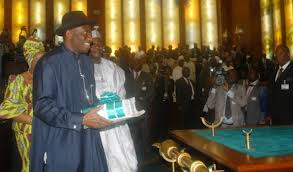
2013 BUDGET: Jonathan Reject Transparency Clause?

0 comments
President Goodluck Jonathan has rejected a number of ambitious stipulations in the Budget Act allowing the Senate and the House of Representatives to monitor every kobo disbursed by the executive for project execution, a design federal lawmakers hatched to check the perennial problem of poor budget implementation.
Mr. Jonathan said the unprecedented clauses, inserted by both chambers into the 2012 budget law after repeatedly complaining about their frustration with dismal budget performance, will encroach on his powers and that of the executive.
In a letter to the National Assembly Tuesday, the president called for immediate review.
“The 2013 Appropriation Act includes some clauses which may be injurious to the spirit of separation of powers and which could hamper the work of the executive arm of government. I, therefore, request that these should be reviewed,” the president said.
The lawmakers had included in its approval of the budget clause 6(2), which demands that the Accountant-General of the Federation, AGF, forward to the National Assembly full details of all funds released to Ministries, Departments and Agencies immediately such funds are released.
If effective, Clause 6(2), more than any other, would allowed a very close monitoring of government spending. But Mr. Jonathan has rejected the move citing separation of powers.
A follow up clause directs that the Minister of Finance release funds periodically as due to offices involved, and failures can only be entertained with the due permission of the National Assembly.
The president said that was impossible since revenues fluctuate and might necessitate budgetary defaults.
“This requires the minister of Finance to seek a waiver from the National Assembly each time the ministry of Finance cannot make full fund releases to the MDAs when due. As you are aware, the nation experiences a shortfall in revenue once in a while and if the minister is to seek a waiver on each occasion, the practice would tie down budget implementation,” he said.
It is not clear whether the lawmakers will oblige Mr. Jonathan.
But the president’s request for change, sent alongside a number of amendments to the 2012 budget, appears to highlight the president’s concern about having the executive’s often criticized unapproved spending, curtailed.
In 2012, lawmakers noted several unbudgeted spending by ministries, departments and parastatals-many of the cash used for those spendings came from internally generated revenue.
Under the president, the cost of petrol subsidy surged consistently more than approved by the National Assembly, peaking at more than N2 trillion in 2011 against the N256 billion budgeted.
But most frustrating to the lawmakers has been the consistent poor implementation of the federal budget, and complaints about refusal by the Ministry of Finance to make fund releases to respective government establishments.
The clauses were amongst a number of reviews by the lawmakers to the budget, a reason the president refused to sign the passed document for months. Others were the oil price benchmark and spending adjustments.
Mr. Jonathan recently signed the budget after extracting the assurances of the two arms of the National Assembly that should he sign the budget, the legislators will approve an immediate follow-up amendment he would send to lawmakers.
The president forwarded the amendment on Tuesday. Alongside other requests, he asked the two arms to reverse the zero allocation to the Security and Exchange Commission, SEC, saying withholding the agency’s funds would affect the capital market.
Mr. Jonathan said the decision to withhold the commission’s budget “tantamount to shutting down the business of the commission with a potential negative impact on the capital market”.
In the amendment the president has requested, N273, 522 billion is to be allocated to the Subsidy Reinvestment programme which lawmakers had earlier dismissed as a scam.
Extra N4 billion is for the East-West road increment, N13 billion for Abuja-Lokoja road, N31.5 billion for Benin-Ore-Sagamu road, an additional N7 billion for Kano-Maiduguri dualisation, N7billion for Port-Harcourt-Enugu-Onitsha road, N7 billion counterpart funding for second Niger bridge and N10 billion for Oweto bridge in Benue State.
Proposed allocation to the Ministry of Transport is N77 billion for Lagos-Kano-Port Harcourt-Maiduguri-Kaduna-Abuja rail project, bringing the total to N213,190 billion.
For social safety nets and infrastructure projects, maternal and child health was allocated  N16.9 billion, public works for youth N27 billion, mass transit N6 billion, vocational training N8.6 billion and culture and tourism, N224  million.
Other include N1 billion for the board of Subsidy Reinvestment and Empowerment Programme and N500 million for monitoring and evaluation, bringing the total expenditure to N273,522 billion.
Read more...

Poor performance in last NECO exams underscores neglect by federal and state governments

0 comments
The results of last year’s November/December Senior Secondary Certificate Examinations recently released by the National Examinations Council (NECO), has once again exposed the precarious state of education in Nigeria. The registrar of the 13-year-old examination body, Professor Promise Okpala, who announced the performance of the candidates said only 33 per cent of the 83, 755 candidates who sat for the English Language paper passed at the required credit level. By the result, given the condition that only candidates who obtain credit passes in five subjects including English Language and Mathematics could gain admission to universities in Nigeria, only 25, 628 of the candidates could achieve their dream this year.
Many young men and women who sat the NECO December examinations have been repeatedly disappointed owing to failure in one or two of the core subjects. This is more so for science students who may not be particularly good at the English language. While the performance in Mathematics, another general core subject, was above the 50 per cent mark, it was not so in the sciences. In Physics, less than one per cent of the 35,000 who sat the examination passed at credit level. Mathematics did not give us a cause for cheer. Only 15 per cent passed while in Chemistry it was 35 per cent.
If the results had been inconsistent with the pattern in recent years, it would not call for consternation, but results from NECO and the sister examination body, the West African Examinations Council (WAEC), over the past five years show that there has been a steady decline in the quality of education offered at all levels.
The nation was first jolted to this reality when, in 2009, 98 per cent of the 234,682 candidates failed to make five credits, including English and Mathematics. Mind-boggling was the level of malpractices as 236,613 cases were recorded that year. It was expected that all stakeholders would be pushed to action and achieve a reversal of the trend within years. The latest results have confirmed that not much has been achieved.
The failure of our teeming youths is the failure of government. Things have been kept at the same level, little has been done to upgrade facilities in public secondary schools and make teaching attractive for prospective students and applicants. The profession has become a fall-back for those who failed to gain the attention of other employers.
Private schools of other shapes and descriptions have since sprung up to fill the vacuum. Even in this wise, there is an obvious failure of supervision and monitoring that has also led to poor performance in external examinations.
Desperate students have thus resorted to abusing and subverting the process. Sometimes aided by parents and teachers, especially in private schools, the candidates do everything to have advance copies of examination papers or pay others to either sit for or assist them in the examination centres. No nation hoping to bridge the development gap between the first and third world could afford such neglect of the education sector.
We call on governments at federal, state and local levels to take urgent, coordinated and concerted steps in adequately funding education. We must go beyond holding workshops and jamborees ostensibly to review laws and rules regulating education in the country. As a first step, funding must improve. While the United Nations Educational, Scientific and Cultural Organisation (UNESCO) has recommended that all governments allocate a minimum of 26 per cent of their budgets to education, the Federal Government has consistently voted below 10 per cent in the past 13 years.
Policy inconsistency resulting from change of ministers has not helped matters. Eight ministers have taken charge in the ministry since 1999. Professors Tunde Adeniran, Babalola Borishade, Fabian Osuji, Dr. Chinwe Obaji, Oby Ezekwesili, Igwe Aja Nwachukwu, Sam Egwu and Ruqayattu Rufai came up sometimes with contrasting policy thrusts.
It must be realised that development in all sectors is hinged on the quality of education and no country can advance without paying special attention to the needs of the youth.
Read more...
 
THE REFORMERS: NEWS © 2011-2014